
Why Seam Sealing Matters in Waterproof Jackets (And Why Without It, Jackets Leak)
Jun 16, 2026
When people buy waterproof jackets, they usually focus on fabric ratings like 5,000mm, 10,000mm, or 20,000mm.
However, there is one critical detail that determines whether a jacket truly stays waterproof in real-world conditions:
Seam sealing
In fact, most waterproof failures do not come from fabric—they come from stitching.
In this article, we explain why seam sealing matters, how it works, and how different sealing methods affect waterproof performance.
What Is Seam Sealing?
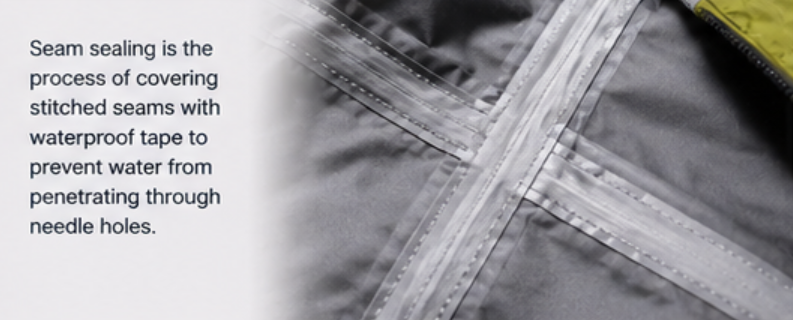
Seam sealing is the process of covering or bonding the stitched seams inside a waterproof garment to prevent water from entering through needle holes.
When a jacket is sewn together, thousands of tiny needle punctures are created along every seam.
Even if the fabric itself is waterproof, these tiny holes can allow water to leak through under rain pressure.
Seam sealing solves this problem by applying a waterproof tape or adhesive layer over the stitching.
Why Do Jackets Need Seam Sealing?
Waterproof fabrics are designed to block water penetration.
However, stitching creates weak points in the structure.
Without seam sealing:
- Water can enter through stitch holes
- Pressure from rain or backpacks increases leakage risk
- Long exposure leads to moisture buildup inside the jacket
This is why seam sealing is essential for any serious outdoor waterproof garment.
How Seam Sealing Works
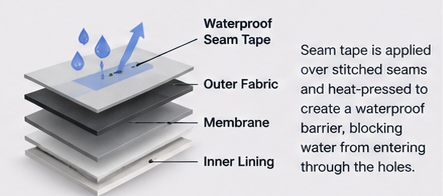
Inside a waterproof jacket, seam sealing tape is applied using heat and pressure.
The tape bonds to the inner fabric layer, covering all stitching holes.
This creates a continuous waterproof barrier.
There are three main steps:
- Stitching the garment panels together
- Applying waterproof seam tape
- Heat-pressing to activate adhesion
Once completed, the seam becomes fully sealed against water penetration.
Types of Seam Sealing
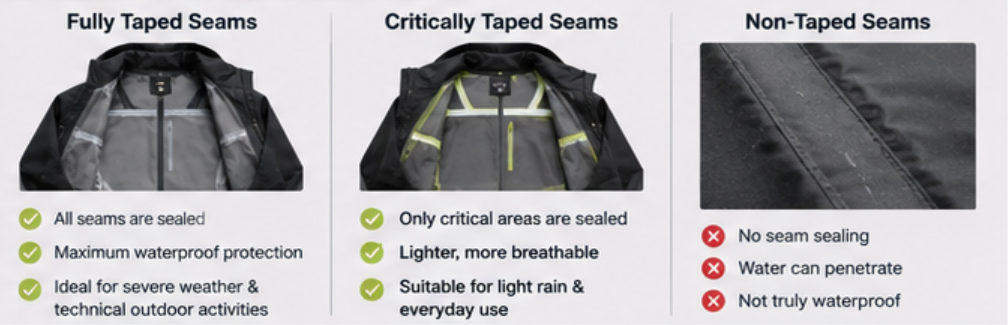
Not all seam sealing is the same. Different levels are used depending on performance requirements.
1. Fully Taped Seams
This is the highest level of protection.
All seams inside the garment are taped.
Best for:
- Heavy rain
- Hiking and trekking
- Mountaineering
- Skiing
- Technical outdoor use
Advantages:
✔ Maximum waterproof protection
✔ Suitable for extreme weather
✔ High durability
2. Critically Taped Seams
Only high-risk areas are sealed, such as:
- Shoulders
- Hood
- Chest
Best for:
- Light hiking
- Urban outdoor wear
- Everyday rain protection
Advantages:
✔ Lighter weight
✔ More breathable
✔ Lower cost
Limitations:
✘ Not suitable for heavy or prolonged rain
3. Non-Taped Seams
No seam sealing is applied.
Best for:
- Fashion jackets
- Light water-resistant clothing
- Casual wear
Limitations:
✘ Not truly waterproof
✘ Water can easily enter through seams
Fully Taped vs Critically Taped: What’s the Difference?
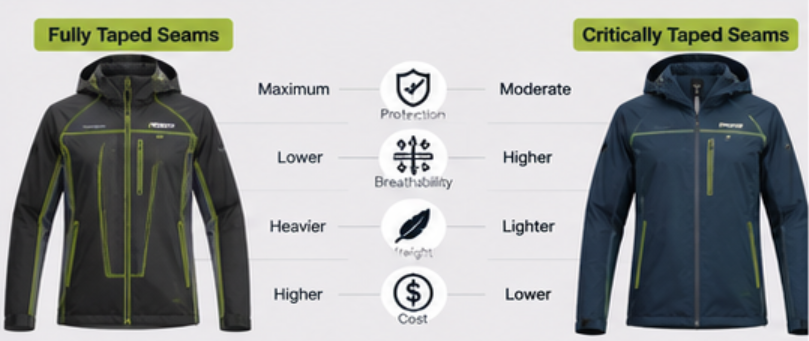
The key difference lies in coverage.
Fully taped seams protect the entire garment, while critically taped seams only protect selected zones.
For example:
- Fully taped = full waterproof protection
- Critically taped = partial protection for light rain
If you are manufacturing or sourcing outdoor apparel, seam sealing level directly determines product positioning in the market.
Why Seam Sealing Is More Important Than Fabric Alone
A common misconception is:
“If the fabric is waterproof, the jacket is waterproof.”
This is not true.
Even the best waterproof fabric will fail if seams are not properly sealed.
Real-world performance depends on:
- Fabric waterproof rating
- Seam sealing quality
- Construction design
- Pressure exposure (backpack, movement, sitting, etc.)
In practice, seam sealing often determines whether a jacket passes or fails in heavy rain conditions.
Where Seam Sealing Matters Most
Seam sealing is especially important in high-stress areas such as:
- Shoulders (backpack pressure)
- Hood seams (direct rain exposure)
- Arm joints (movement stress)
- Chest panel seams (front rain impact)
These areas are most likely to leak without proper sealing.
Common Misconceptions About Seam Sealing
Myth 1: Waterproof Fabric Is Enough
False.
Without seam sealing, stitching holes remain open pathways for water.
Myth 2: All Waterproof Jackets Are Fully Taped
Not true.
Many entry-level jackets only use critically taped seams or no sealing at all.
Myth 3: Seam Sealing Makes Jackets Heavy
Modern seam tape is extremely lightweight and does not significantly affect comfort.
Myth 4: Seam Sealing Never Fails
Over time, seam tape can degrade due to washing, heat, and wear.
Proper care is required.
How Manufacturers Test Seam Sealing Quality
Professional outdoor apparel manufacturers test seam sealing through:
- Hydrostatic pressure tests
- Rain chamber testing
- Flex durability tests
- Wash cycle durability tests
These tests ensure seam integrity under real-world conditions.
Seam Sealing and Product Positioning
For outdoor apparel brands, seam sealing level is not just a technical detail—it is a product strategy.
- Fully taped → premium technical gear
- Critically taped → mid-range outdoor lifestyle
- Non-taped → fashion or light rainwear
Understanding this helps define pricing, target customers, and market positioning.
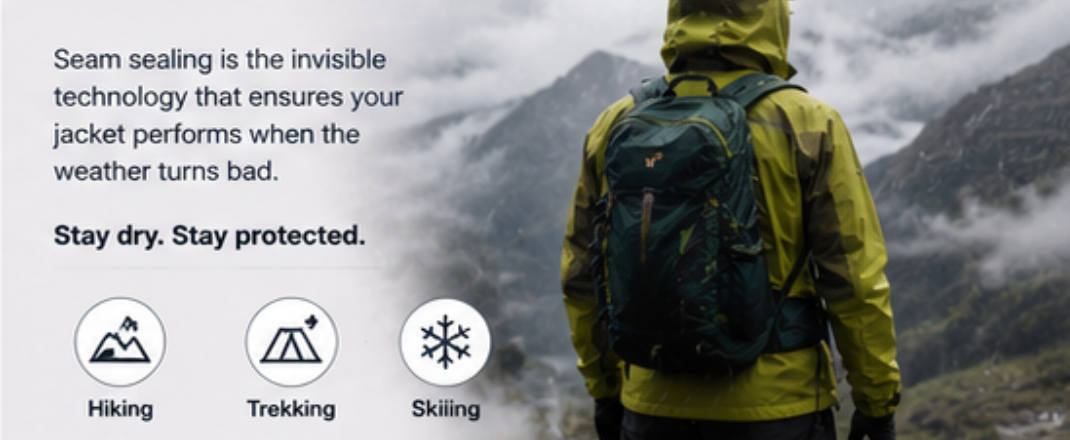
Seam sealing is one of the most important—but often overlooked—technologies in waterproof jackets.
While waterproof fabrics block rain, seam sealing ensures there are no weak points where water can enter.
For high-performance outdoor apparel, both fabric technology and seam construction must work together.
If waterproof fabric is the shield, seam sealing is what closes the gaps.
Without it, even the best jacket can leak.